
Showing posts with label Review. Show all posts
Showing posts with label Review. Show all posts
Monday, March 8, 2010

Lecture 8: Copy Editing & Proofing

- Copy Editing and Proofing Differences
- Spelling
- Copy Editing Practise
- Add to E- Portfolio
- Homework
Copy Editing
- Editing or copyediting checks for errors in spelling, grammar, punctuation and usage in text that has not been formatted yet.
- Ensures proper and consistent use of voice, style, sentence and paragraph construction.
- Does not include changes in content, nor does it always ensure that the written document is logical, factually complete or accurate; but it does ensure clean, decisive writing that is free of errors.
- Copy editors may suggest changes to clarify the writer's intended message or to improve the fluency of the written text; and they may query the author about content or wording that does not seem to be accurate or logical; but they do not change the content of the copy.
- Editing should always precede proofreading.
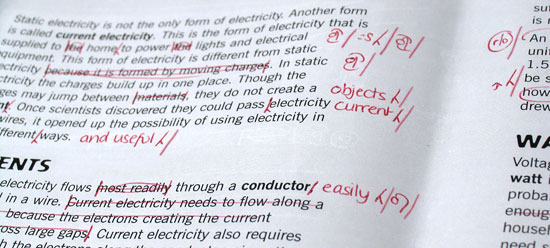
Proofing
- Proofreading brings one final look at documents that have already been edited and formatted, whether by one or several individuals
- Proofing focuses on typing mistakes, missing words, punctuation, capitalisation etc...
- Check for any remaining errors and inconsistencies in use of grammar, language and format.
Activity/Practise
- Choose THREE blog posts written by students in class (just not your own)
- Copy edit and proofread the THREE posts
- Include your suggestions/corrections in the comments of each post
- Remember to remain professional in language use and tone

Spelling
- Review page 64 in your texts
- Note differences between Canadian and American spellings
- Remember “practise” = verb, “practice” noun
15-20 minutes
E-Portfolio
- Opportunity to add to your E-Portfolio
- You may also take this time to edit any posts you already have drafted
- Remember to label appropriately
- Include links, images and copyright information
Homework
Blog Report 2 Due at the end of (next) class so come prepared! You will have the class time to work on your report.
(remember to label correctly)
Note: Top image from La Pierre Editing, Proofreading Image from Graphic Design Employment, Primitive Spelling Bee image from Mrs. Cummins' Classroom.
Tuesday, March 2, 2010

Monday, March 1, 2010
Chapter 5,Critical Interpretation, Isaac
Purpose
-This text is about the various tools that copy editors have available to them for fact checking various things within articles, and checking the reliability of sources and the such. The author of this work wants the reader to know the various tools, indexes and other bits of knowledge the copy editor has available to them. The author wants the reader to know how to successfully know how to referance various sources and assert its reliability, as well as learn how to be knowledgeable of all the various lists, indexes, sites and more the copy editor in the newsroom has available to them. People who need a quick run down of what copy editing is all about would most likely read this text.
Structures and Features
The same structures and features that you would expect to see in any scholarly or acedmic text are present here. Bolded keywords, italic bolded words, bullets, broken up block text are the norm here and it stays the same throuh out. Minimal diagram usage is present, and acedmic tone is used throughout...there is no ulterior meaning to the text here.
Power
Is the text fair? Sure it is. There really is no bias present here, except a minor one possibly towards copy editors, as this is a prominently copy editing and proof reading text book...go figure.
Gaps
There is no real gaps to speak of...the book is all about proof reading and copy editing, plain and simple. People who have no real interest in the topic at hand (that is journalism, and within it, copy editing and proof reading in the newsroom)probobly wouldn't have a reason to crack the binding on this text book;however, for those in need of a crash course in proof reading and copy editing, there is vital information that covers the basics of this scholarly art.
-This text is about the various tools that copy editors have available to them for fact checking various things within articles, and checking the reliability of sources and the such. The author of this work wants the reader to know the various tools, indexes and other bits of knowledge the copy editor has available to them. The author wants the reader to know how to successfully know how to referance various sources and assert its reliability, as well as learn how to be knowledgeable of all the various lists, indexes, sites and more the copy editor in the newsroom has available to them. People who need a quick run down of what copy editing is all about would most likely read this text.
Structures and Features
The same structures and features that you would expect to see in any scholarly or acedmic text are present here. Bolded keywords, italic bolded words, bullets, broken up block text are the norm here and it stays the same throuh out. Minimal diagram usage is present, and acedmic tone is used throughout...there is no ulterior meaning to the text here.
Power
Is the text fair? Sure it is. There really is no bias present here, except a minor one possibly towards copy editors, as this is a prominently copy editing and proof reading text book...go figure.
Gaps
There is no real gaps to speak of...the book is all about proof reading and copy editing, plain and simple. People who have no real interest in the topic at hand (that is journalism, and within it, copy editing and proof reading in the newsroom)probobly wouldn't have a reason to crack the binding on this text book;however, for those in need of a crash course in proof reading and copy editing, there is vital information that covers the basics of this scholarly art.
Chapter 5: Critical Interpretation by Dale Boyd

Purpose
Chapter 5 focuses on providing an overviews the most useful reference materials for fact-checking. The methods for fact-checking provided are mainly for aspiring copy editors who need to be able to quickly verify things such as the example in the text "Was Canada's first prime minister a Macdonald or a MacDonald?" (96).
Structure
The structure of the text in the chapter is pretty much the exact same throughout. The chapter consists of minimal diagrams and is really not much more but standard bullet points and blocks of text. The language used is pretty straightforward and mundane, usually standard in textbooks.
Power
The text is completely un-biased and fairly un-charged, it does show a tendency towards copy editing as being of great importance in the newsroom, it also provides evidence to back up this claim demonstrating what copy editors have to do in their day to day.
Gaps
This text is not really intended for those who wouldn't have a use for copy editing; however, for those in need of such skills it covers a bunch of ways to fact-check in short notice.


Chapter 5: Critical Interpretation, Susan Eder
PURPOSE
Chapter five is about checking sources for reliability. One way copy-editors check facts is by referring to indexes. The author of the text wants the reader to understand the importance of checking facts for accuracy to give credibility to the author and to separate the professional writers from amateurs. The author wants the reader to use the various Internet tools available to check for accuracy. These tools include the use of newsgroups, lists, discussion groups and electronic databases. The author also wants to show the reader how to find information on the Internet. The people who would read or view this text include anyone interested in the ways that new technology can assist them in their job. They may work as copy-editors, proofreaders, journalists, or anyone else who needs to find reliable sources to check information for accuracy. The text is written for anyone wanting to be considered credible, reliable and accurate.
STRUCTURES AND FEATURES
The text is structured in categories with sub-headlines. Each section uses paragraphs and either numbered lists or bullets. The use of bold and the use of different text sizes do not help to make the information more exciting. The text uses figures to break up the text, but the figures are just large pieces of too much information. The style used in the design of the text suggest that the audience is academic. The figures explain the elements that make up a web address, a check list for checking website accuracy and a list of discussion groups to subscribe to. There are no images in Chapter five. The language used is formal and the words suggest that a level of professional understanding is needed to comprehend what is being read.
POWER
The text is fair in that it includes the value of both professional and amature reporters. The text explains any uncommon terms the reader may not understand. The text also explains the abbreviations that are used. The people and groups that are seen in "good light" are the authors of professional sites as professional sites are viewed as credible. Perhaps the people who are not seen in "good light" are citizen journalists and amateur writers. We need to be able to check their information for credibility. The text serves the Internet for anyone who cares about accuracy and wants to be considered reliable and correct in their reporting and publishing responsibilities. The reader is the one who benefits when the text is accurate.
GAPS
The people not heard from in Chapter five are the people who do not represent professionalism. These are the bloggers, the tweeters and others who make up the general public. This text is not intended for columnists and others trying to express their opinions. The text describes different processes but leaves out why they are so. The history is missing. Also the text avoids to give any information on who to contact for help. The additional reading list may be of use, but it is not personal, just geared to textbooks and such. I would have liked to learned in this Chapter about specific Internet sites that can help journalists check for accuracy. Mostly the text covered enough if not too much information for the average copy-editor or proofreader.
Chapter five is about checking sources for reliability. One way copy-editors check facts is by referring to indexes. The author of the text wants the reader to understand the importance of checking facts for accuracy to give credibility to the author and to separate the professional writers from amateurs. The author wants the reader to use the various Internet tools available to check for accuracy. These tools include the use of newsgroups, lists, discussion groups and electronic databases. The author also wants to show the reader how to find information on the Internet. The people who would read or view this text include anyone interested in the ways that new technology can assist them in their job. They may work as copy-editors, proofreaders, journalists, or anyone else who needs to find reliable sources to check information for accuracy. The text is written for anyone wanting to be considered credible, reliable and accurate.
STRUCTURES AND FEATURES
The text is structured in categories with sub-headlines. Each section uses paragraphs and either numbered lists or bullets. The use of bold and the use of different text sizes do not help to make the information more exciting. The text uses figures to break up the text, but the figures are just large pieces of too much information. The style used in the design of the text suggest that the audience is academic. The figures explain the elements that make up a web address, a check list for checking website accuracy and a list of discussion groups to subscribe to. There are no images in Chapter five. The language used is formal and the words suggest that a level of professional understanding is needed to comprehend what is being read.
POWER
The text is fair in that it includes the value of both professional and amature reporters. The text explains any uncommon terms the reader may not understand. The text also explains the abbreviations that are used. The people and groups that are seen in "good light" are the authors of professional sites as professional sites are viewed as credible. Perhaps the people who are not seen in "good light" are citizen journalists and amateur writers. We need to be able to check their information for credibility. The text serves the Internet for anyone who cares about accuracy and wants to be considered reliable and correct in their reporting and publishing responsibilities. The reader is the one who benefits when the text is accurate.
GAPS
The people not heard from in Chapter five are the people who do not represent professionalism. These are the bloggers, the tweeters and others who make up the general public. This text is not intended for columnists and others trying to express their opinions. The text describes different processes but leaves out why they are so. The history is missing. Also the text avoids to give any information on who to contact for help. The additional reading list may be of use, but it is not personal, just geared to textbooks and such. I would have liked to learned in this Chapter about specific Internet sites that can help journalists check for accuracy. Mostly the text covered enough if not too much information for the average copy-editor or proofreader.
Sunday, February 28, 2010
Lecture 7: Headline Practise

- What is the purpose of a headline?
- What are the different types and styles of headlines in modern newspapers?
- How have computers changed the methodology employed in headline writing?
- What makes an effective headline?
- What makes a headline "good" or "bad?"
- What is the difference between news headlines and feature headlines?
- How do you know if a headline will fit in the allotted space?
- What kinds of questions can I ask myself in determining whether my headline is effective?
Activity 1:
Read the following headlines collected in the 2007 edition of The Lower Case (Columbia Review of Journalism). Note, as a comment, what is incorrect or humorous in these headlines:
Guest-worker plan proposed
Texas police want bullet lodged in teenager's head
The (London) Independent 12.23.06
Fifth Avenue clogged with police shooting protestors
The Post-Standard (Syracuse, N.Y.) 12.17.06
U.S. pilots in Brazil crash back at home
The Press of Atlantic City 12.10.06
Will hanging help Bush?…
Activity 2:
What are the elements of headline writing? What are some purposes of headlines? Add your answers in the form of a WORDLE (word cloud). Then, post your Wordle as a blog post. You'll need to create your Wordle, then save it to the public gallery and finally, copy the HTML code that appears at the bottom of the page. You'll then paste the HTML code into your blog (when in "Edit HTML" mode, NOT in the "compose" mode).
Your blog title should be: Headline Wordle, Student Name. The labels for your post should be: lecture 7, review, headlines.
Here is an example of a Wordle that I did using information from Chapter 9:
What are the elements of headline writing? What are some purposes of headlines? Add your answers in the form of a WORDLE (word cloud). Then, post your Wordle as a blog post. You'll need to create your Wordle, then save it to the public gallery and finally, copy the HTML code that appears at the bottom of the page. You'll then paste the HTML code into your blog (when in "Edit HTML" mode, NOT in the "compose" mode).
Your blog title should be: Headline Wordle, Student Name. The labels for your post should be: lecture 7, review, headlines.
Here is an example of a Wordle that I did using information from Chapter 9:

Activity 3:
Go to the Huffington Post and read a few articles and then identify elements of strength and/or weaknesses you find in the headlines. Then read a short feature article, and similarly think about its headline. Examine differences in style, sensitivity, when humor is appropriate, inappropriate. Note the use of verbs, need for extensive "shorter word" vocabulary, etc. Then evaluate the headlines according to the "Characteristics of Good Headlines" in Chapter 9. Add your thoughts as a comment to this lecture post.
Activity 4:
Compare headlines from the Huffington Post with column width, typographical specs and spacing (how the headline must also fit within predetermined space) as explained in Chapter 9. Did you find any headlines that were too long or too short? How might you change them to fit with rules noted in Chapter 9? Add a comment here.

Activity 5:
Review the vocabulary list on page 181. Note the importance of shorter synonyms to ensure clear and precise headlines. Choose ten words from the vocabulary list and add at least two other synonyms not noted in Chapter 9. Also, include two or three words that don't appear in this list along with your own shorter synonyms. Add your vocabulary information to a blog post. Title: Vocabulary Builder. Labels: lecture 7, headlines, stylistics. Remember to include an image in your post.
Activity 6:
If time permits, we can finish the class by adding to your E-Portfolios. You may choose to edit posts you have already written, or begin a new one.
Homework:
Practise spelling and review vocabulary
Come to class with a topic to add to your E-Portfolio
Note: Question mark sign image from Illinois Wesleyan University and newspapers image from 24/7 Wall St.
Tuesday, February 23, 2010
Chapter 5: Critical Interpretation, Matt White
Purpose
This chapter covers the reliability of reference sources, Indexes (what they are and how to use them), how to use internet search engines and discussion groups, Usenet newsgroups, and finally, the role and function of commercial electronic databases. The author of the text wants to get the message across of how important accuracy is in journalism, and reliable ways of obtaining accurate information on the internet. I see this information being valuable to anyone who is interested in getting accurate information off the internet. I see it being especially useful for those who may not be so familiar with the internet, and haven’t already developed the skills necessary to properly use the internet for info.
Structures and Features
I find he structure this particular chapter follows to be very mundane. It is roughly 15 pages of paragraph after paragraph after paragraph, with no pictures, charts, or anything significant enough to give my poor eyes a break. There is a small attempt of breaking up the text with bullet lists, greyed boxes, and bold subheads, but it doesn't come close to overcoming the intense amount of tiny text. The design of the text seems to suggest that it was written to be presented in an academic textbook format (go figure). The one thing that could be considered an image was the "How to Unravel a Web Address" box. It did exactly what the title suggests by pointing out the various points of a web address and what they each represent and what they're used for. The language used is clearly formal/academic.
Power
I think that the text is very fair. It does an excellent job of giving an extremely in-depth look at finding reliable information on the internet. As far as people being seen in good or bad lights, the text does give some bias, but it is rightly so. The text points out the reliability of academic or professional sites over amateur or citizen pages. While this may shed an unfair light on all the citizen information out there that is accurate, the insane amount of garbage on the internet requires us to surf cautiously and be sceptical of anything not done by professionals. The text in this chapter serves the interest of anyone with reliable information on the internet. Even if the information is presented via citizen participation, reliable information is being praised throughout this entire chapter, and that can only help the accurate citizen.
Gaps
I guess you could say that the people who are "seen but not heard" in the chapter would be all those people who have contributed information to massive databases. These databases are primarily used for fact checking as opposed to enjoyable reading. This tends to draw attention away from the piece as a whole or the authors themselves. It leads to skimming for facts instead of reading the piece as a hole. I would say that this text would obviously not be intended for anyone who isn't interested in the subject at hand. I don't feel that the text left out any impertinent information; in fact, I thought it went a bit too far and actually should have included less information.
This chapter covers the reliability of reference sources, Indexes (what they are and how to use them), how to use internet search engines and discussion groups, Usenet newsgroups, and finally, the role and function of commercial electronic databases. The author of the text wants to get the message across of how important accuracy is in journalism, and reliable ways of obtaining accurate information on the internet. I see this information being valuable to anyone who is interested in getting accurate information off the internet. I see it being especially useful for those who may not be so familiar with the internet, and haven’t already developed the skills necessary to properly use the internet for info.
Structures and Features
I find he structure this particular chapter follows to be very mundane. It is roughly 15 pages of paragraph after paragraph after paragraph, with no pictures, charts, or anything significant enough to give my poor eyes a break. There is a small attempt of breaking up the text with bullet lists, greyed boxes, and bold subheads, but it doesn't come close to overcoming the intense amount of tiny text. The design of the text seems to suggest that it was written to be presented in an academic textbook format (go figure). The one thing that could be considered an image was the "How to Unravel a Web Address" box. It did exactly what the title suggests by pointing out the various points of a web address and what they each represent and what they're used for. The language used is clearly formal/academic.
Power
I think that the text is very fair. It does an excellent job of giving an extremely in-depth look at finding reliable information on the internet. As far as people being seen in good or bad lights, the text does give some bias, but it is rightly so. The text points out the reliability of academic or professional sites over amateur or citizen pages. While this may shed an unfair light on all the citizen information out there that is accurate, the insane amount of garbage on the internet requires us to surf cautiously and be sceptical of anything not done by professionals. The text in this chapter serves the interest of anyone with reliable information on the internet. Even if the information is presented via citizen participation, reliable information is being praised throughout this entire chapter, and that can only help the accurate citizen.
Gaps
I guess you could say that the people who are "seen but not heard" in the chapter would be all those people who have contributed information to massive databases. These databases are primarily used for fact checking as opposed to enjoyable reading. This tends to draw attention away from the piece as a whole or the authors themselves. It leads to skimming for facts instead of reading the piece as a hole. I would say that this text would obviously not be intended for anyone who isn't interested in the subject at hand. I don't feel that the text left out any impertinent information; in fact, I thought it went a bit too far and actually should have included less information.
Monday, February 8, 2010
Editing For Print and Online, Isaac & Dale.
The First Edition
Bulks of stories at daily newspapers should move to morning news editors by late afternoon/evening; Late breaking stories/front page stories should be completed by now as well.
CP provides “front advisory” to inform editors across Canada of what stories major dailies are placing front page.
The Story Conference
Wire Editors usually prepare for morning story conference/budget meeting, while they process news-service copy for the first edition.
CP sends member newspapers alerts on developing stories.
CP sends member newspapers alerts at 1 P.M of the day’s main stories. At 3 P.M the first write-thru is sent, updating the first advisory, and then again at 7:30 p.m.
Depending on paper’s manpower, editors of their respective sections attend story conferences.
At this time editors discuss stories that are ready/will be shortly ready for the day’s editions and decide which stories get front page coverage.
Decisions of which photographs will be used are also made.
During and after the Crunch
Deadlines between multiple editions of a morning newspapers are usually no more than an hour apart. Wire editors must work quickly and work closely with the news editor to put successful follow0up for the first edition.
The wire editor will frequently check with the news editor to see what requested stories the news editor had sent to them by other editors. The wire editor will update the news editor when stories are updated to see if they should be edited, if the changes are minor, they are usually not minded.
By 11 P.M the bulk of the wire editor’s work for the day’s editions are usually done; by midnight, the wire editor should have all the queues clean. They then take out advisories intended for editors and printing copies for managing editor, assistant managing editor and the news editor.
Copy editors are responsible for sorting out/distributing news-service material to different newspaper sections, for avoiding duplicated published stories, for choosing the best version of a story from various news services and merge these several versions into one story, as well as deciding top national/international stories for the day.
The wire editor works closely with those in charge of the publication’s computer systems to find the most efficient way to retrieve, sort, and store vast volumes of variety of news-service material transmitted day to day.
Editing For The Web
Editors and publishers in the 90’s predicted websites would result in the demise of traditional print media.
Instead, the internet has proved to be an ally to print media, allowing newspapers/magazines to directly compete with broadcast media as the public’s primary source of information.
The web moves beyond just plain text that comes on a page with a 24 hour lag. It allows news groups to cover stories greater in depth with greater speed than before, and allows the employment of multiple media to tell the story in ways neither print nor broadcast media can.
Online journalism has its setbacks. Accuracy is threatened in competitor’s rushes to post stories seconds earlier; the print press no longer determines breaking news deadlines.
Everyone and anyone with the ability to blog is the competition on the web; however, readers and viewers who want to be certain of their information still rely on the familiar brands: Globe and Mail, The Times, Edmonton Journal, etc;
News websites are a fusion of different features; They resemble wire services in that stories are constantly updated with new info by editors, they also resemble bulletin boards as all content from a particular day’s print edition is herein posted. Finally, they also resemble their parent brand as reporters are still sent out to report for stories that will be posted online.
News websites are more than a wire service; they combine text, graphics, and video and audio into the ultimate form of info delivery, which requires technologically literate readers.
Newspapers often use their online sites as teasers into their daily stories, in attempts to entice viewers to buy that day’s issue to get the full scoop.
On the other hand, newspapers use their print editions to advertise online service that may even offer their readers additional insight and information into stories that are unavailable for updated in the printed medium.
Newspapers also gain additional advertising opportunities on their online sites, allowing for additional revenue which is a requirement in today’s economy, in which printed mediums are lagging.
Online, websites that contain web, graphics, animations and other multi-media applications still attract a fair amount of attention, but sites that mainly use just text are still the staple form of online news delivery.
The web’s hypertext structure, along with the glut of info it offers, requires copy editors to give special attention to these considerations to make the story as efficiently planned out as possible, for optimum scanability, search engine optimization, and the careful placement of images, bullets and links within the story .Placing links within the story, which link to other sites that may act as further background information, keeping sentences short, as well as paragraphs, use the inverted pyramid approach, and keep the overall story short and sweet. Smart headlines, and constantly updates (as much as possible) are key for online.
Check out this SlideShare Presentation:
Bulks of stories at daily newspapers should move to morning news editors by late afternoon/evening; Late breaking stories/front page stories should be completed by now as well.
CP provides “front advisory” to inform editors across Canada of what stories major dailies are placing front page.
The Story Conference
Wire Editors usually prepare for morning story conference/budget meeting, while they process news-service copy for the first edition.
CP sends member newspapers alerts on developing stories.
CP sends member newspapers alerts at 1 P.M of the day’s main stories. At 3 P.M the first write-thru is sent, updating the first advisory, and then again at 7:30 p.m.
Depending on paper’s manpower, editors of their respective sections attend story conferences.
At this time editors discuss stories that are ready/will be shortly ready for the day’s editions and decide which stories get front page coverage.
Decisions of which photographs will be used are also made.
During and after the Crunch
Deadlines between multiple editions of a morning newspapers are usually no more than an hour apart. Wire editors must work quickly and work closely with the news editor to put successful follow0up for the first edition.
The wire editor will frequently check with the news editor to see what requested stories the news editor had sent to them by other editors. The wire editor will update the news editor when stories are updated to see if they should be edited, if the changes are minor, they are usually not minded.
By 11 P.M the bulk of the wire editor’s work for the day’s editions are usually done; by midnight, the wire editor should have all the queues clean. They then take out advisories intended for editors and printing copies for managing editor, assistant managing editor and the news editor.
Copy editors are responsible for sorting out/distributing news-service material to different newspaper sections, for avoiding duplicated published stories, for choosing the best version of a story from various news services and merge these several versions into one story, as well as deciding top national/international stories for the day.
The wire editor works closely with those in charge of the publication’s computer systems to find the most efficient way to retrieve, sort, and store vast volumes of variety of news-service material transmitted day to day.
Editing For The Web
Editors and publishers in the 90’s predicted websites would result in the demise of traditional print media.
Instead, the internet has proved to be an ally to print media, allowing newspapers/magazines to directly compete with broadcast media as the public’s primary source of information.
The web moves beyond just plain text that comes on a page with a 24 hour lag. It allows news groups to cover stories greater in depth with greater speed than before, and allows the employment of multiple media to tell the story in ways neither print nor broadcast media can.
Online journalism has its setbacks. Accuracy is threatened in competitor’s rushes to post stories seconds earlier; the print press no longer determines breaking news deadlines.
Everyone and anyone with the ability to blog is the competition on the web; however, readers and viewers who want to be certain of their information still rely on the familiar brands: Globe and Mail, The Times, Edmonton Journal, etc;
News websites are a fusion of different features; They resemble wire services in that stories are constantly updated with new info by editors, they also resemble bulletin boards as all content from a particular day’s print edition is herein posted. Finally, they also resemble their parent brand as reporters are still sent out to report for stories that will be posted online.
News websites are more than a wire service; they combine text, graphics, and video and audio into the ultimate form of info delivery, which requires technologically literate readers.
Newspapers often use their online sites as teasers into their daily stories, in attempts to entice viewers to buy that day’s issue to get the full scoop.
On the other hand, newspapers use their print editions to advertise online service that may even offer their readers additional insight and information into stories that are unavailable for updated in the printed medium.
Newspapers also gain additional advertising opportunities on their online sites, allowing for additional revenue which is a requirement in today’s economy, in which printed mediums are lagging.
Online, websites that contain web, graphics, animations and other multi-media applications still attract a fair amount of attention, but sites that mainly use just text are still the staple form of online news delivery.
The web’s hypertext structure, along with the glut of info it offers, requires copy editors to give special attention to these considerations to make the story as efficiently planned out as possible, for optimum scanability, search engine optimization, and the careful placement of images, bullets and links within the story .Placing links within the story, which link to other sites that may act as further background information, keeping sentences short, as well as paragraphs, use the inverted pyramid approach, and keep the overall story short and sweet. Smart headlines, and constantly updates (as much as possible) are key for online.
Check out this SlideShare Presentation:
Editing For Print and Online
View more presentations from Boyddale12.
Chapter 4, Eder, Susan, Smith, Chelsey
Hard news lead stories answer the five Ws.
The copy editor keeps a balance between reader and writer.
Besides fixing mechanical mistakes editors also watch out for basic reporting guidelines that are fair and balanced.
Reporters should confirm information in Press Releases.
Editors look for holes in stories, missing information, the use of jargon and put numbers into context so reader can understand what they mean.
Note: Powerpoint image from Council Rock School District
The copy editor keeps a balance between reader and writer.
Besides fixing mechanical mistakes editors also watch out for basic reporting guidelines that are fair and balanced.
Reporters should confirm information in Press Releases.
Editors look for holes in stories, missing information, the use of jargon and put numbers into context so reader can understand what they mean.
Note: Powerpoint image from Council Rock School District
Chapter Four, Susan, Chelsey
View more presentations from susanchelsey.
Chapter 4, Katie and Erik
Key Terms
Canadian Press (CP)
Associated Press (America)
Reuters (United Kingdom)
Agences France-Presse (France)
News Sources
PR News Wire
Clutter and Jargon
Budgets (news digest)
CP priority codes
News Feeds & Editors
View more presentations from Katie.
This section discusses the roles of the editors and how they used their available news services to create an up-to-date and relevant newspaper for their readers.
Chapter 4, Tyler Grant & Nancy Gordy
 In the abyss that is Chapter 4, Nancy and Tyler have discoverd the importance of accuracy in words. Their... no, there... wait... They're henceforth going to be more aware of silly mistakes that will render them appearing foolish. When they got to the "eliminating redundancies" section they learned to elimintate redundancies because they didn't want to be redundant or repeat themselves. The "editing story" section proved to be a Hurculean task. The who, the what, the where, then when, and the how must be
  speckled throughout the lead, and dotted throughout the rest of the story should they not work in the opening.
After the opening of the story, the transitions proved to be a monumental task as well. Then, the two wordsmith compatriots tackled chronology and flow of stories. They pondered this for a few minutes before finally moving onto finishing up the required slideshow and this trite little set of paragraphs.
Chapter 4, Matt White and Trevor Robb
Our slideshow was pretty straight forward. It was all about quotations and their proper format. Everything from partial quotes, stutter quotes, inbeded quotes, and a variety of editing techniques were briefly explained in a effort to summerize pages 77 to 83 in the "Creative Editing For Canadian Journalists."
Handling Quotations
View more presentations from Matt.
Monday, January 18, 2010
Chapter One Review and Interpretation, Nancy Gordy and Susan Eder
 A copy editor's job includes but is not limited to: assisting in adding creativity to stories, correcting spelling and grammatical errors, editing and organizing photo's and articles as well as determining placement, writing headlines and cut lines, and assiting in the determination of what is newsworthy. To determine what is newsworthy one must consider certain aspects such as: timeliness, proximity, relevance, conflict, unusualness, and prominence. Characteristics of a good copy editor include: being very factual, being well travelled, being well read in both fiction and non-fiction, having a post-secondary education, having experience working for a newspaper, having a good understanding of what is newsworthy, beeing a good writer, as well as being a good journalist but with more focus on being a good writer.
There are many steps to getting an article distributed and a copy editor is involved in many of the steps throughout. A newspaper would produce evidently lower quality material without good copy editors. Mistakes lead to questioning of the facts presented. Copy editors play a large role in reducing the likeliness of this occuring. They help build a strong reputation.
"Brochures are based on a set of very distinct production considerations" (Bowles 13). Brochures can take up to 3-4 months to complete. A timeline should be followed in order to ensure the final product will be completed on time.Chapter 1 Interpretation:
This chapter outlined the many skills that a copy editor has in order to be successful as well as the importance of good copy editing skills. There are many characteristics that build a good copy editor. A modern newsroom was traditionally shaped as a horseshoe but is changing to adapt to online news. The editing process involves many steps in both a news story and a brochure where a copy editor plays a large role. In Chapter 1 we believe the difference between proofreading and copy editing should have been defined. In our opinion this would help give us a better understanding of what is to come throughout the course.
Note: Image from mattwright on flickr.
Subscribe to:
Posts (Atom)


