Showing posts with label E-Portfolio. Show all posts

Friday, April 16, 2010

Editing Detective, Susan Eder

Image courtsey of CARTOONSTOCK


1) Edmonton Sun, April 16, 2010
by Thane Burneltt

PROBLEM: Wrong Spelling

“There’s no child stumbling onto this online,” he tells QMI Agency, adding parents should be more troubled by their children watching another instalment of the hard-core torture franchise, Saw.

SOLUTION: change instalment to installment

2) Edmonton Journal, April 16, 2010
Alberta education team to visit Northland school communities
by Sarah O'Donnell

PROBLEM: Sentences are extremely long for on-line writing.

This sentence has 51 words:
The detailed look at the Northland School Division comes at the request of Education Minister Dave Hancock, who made the dramatic decision to disbanded the district’s board of trustees in January, citing concern about student performance, high school graduation rates and other problems, such as a new $12.5-million school sitting empty.

This sentence has 53 words:
The inquiry team — made up of David van Tamelen, a former superintendent of the Peace River school division, Nathan Matthew, former chief of the Simpcw First Nation and the Shuswap Nation Tribal Council, and Keith Wagner, former deputy superintendent of the Grande Prairie school district — is to have a final report with advice on the future of Northland to Hancock by the fall.

SOLUTION: Break up sentences into shorter sentences. Avoid the use of "and" and try not to use so many commas.

The blog post by Isaac Kaplyuk also has some good examples of errors found online.

As I was going to the market on Sunday April 18, 2010 I noticed this sign posted at the KFC on 111 Ave close to Westmount. So I took a picture and here's what I saw.
"BUKET" is definitely not a word. The correct word should be "BUCKET". I presume they left out the "C" as there wasn't room for it; however, it would have been much better to leave out the word "new" and put "variety" and "bucket" on separate lines. Leaving out a letter in the sign makes me wonder - Do they leave out the chicken in a chicken sandwich? Do they leave out the napkins in a take-out order? What else do they leave out?

Grammar and Punctuation, Susan Eder

Image courtesy of FHS Wolves Den

Grammar is important. We use language to communicate. To understand each other we have rules that we follow. The rules of correct grammar and punctuation are not to punish us, but to make our comprehension of what we read easier. When we use these tools correctly we sharpen the meaning of our message. Our reader can then understand what we meant to say without having to try and Analise our story.

Improper use of grammar and punctuation damages credibility. How can something be accurate if the writer can't make his writing accurate. Wrong usage makes the writer sound uneducated. There are no excuses for not learning the correct rules. Copy-editors soon get tired of lazy writers who submit copy that is full of errors. Also to get that job in the first place a writer should be able to write error free. Writers should learn the common pitfalls to avoid when constructing sentences. And writers should always have reference books like the CP Stylebook and Creative Editing for Canadian Journalists handy.

It is interesting to see in Jess's blog post pictures she has posted which contain errors.

Editing Stories, Susan Eder


Image courtsy of Gawker

Copy-editors have many job duties in today's technological world. No longer do copy-editors just read and correct copy and write columns. Today's modern copy-editor has many other resposibilities. Chelsey Smith also has a good blog post on editing and proofreading. Responsibilities of the modern copy-editor are as follows:
  • Editing Leads
  • Checking for holes in the story
  • Making sure numbers are accurate
  • Check word usage for accuracy
  • Eliminate redundancies
  • Edit story structure
  • Use of transitions
  • Handling Quotations
  • Shortening stories
  • Editing new-service copy
  • The wire editor's job
  • Editing for the web

Copy-editors, therefore, must make sure that the story is balanced, accurate and fair. They must consider legal implications. They must make use of appropriate leads. The must check the story for any information gaps and check to make sure the structure is consistant. Number, statitics, attributes and quotations must all be checked for for accuracy. Reduncancies and superfluous information needs to be taken out. Also today's copy-editor's need to be able to use social networking sites such as Twitter and Facebook and need to be familar with the world of blogs. Characteristics of copy-editing techniques can be found on the web.

Tuesday, April 13, 2010

Final Blog Post, Susan Eder

Image from ICIS Chemicals Confidential

This may be the final blog post of the year, but for me I hope to continue blogging after the course is over. This is quite a change from how I felt at the beginning of the year when I didn't want to blog at all. I think when something is not familiar there is no reason to need, or want it. Perhaps I will eventually have a personal blog post. That is something positive that I can take away from this course.

As for Twitter, I think I will probably never use it very much again. Maybe if I want to catch the breaking news stories, or for a job, but for personal use - not going to happen. I think about all the things that are recorded about me without my consent already. Things like cameras in stores, and on streets are invasive enough. Everything you post is there forever. And that's a long time. Comments posted on social networking sites stay there forever and can be seen by everyone. I am not sure I want to share my personal life with strangers that way.

A copy-editor may need to tweet and blog, like a painter may need to mix paint and prep walls. But the main job of a copy-editor should be copy-editing, just like the main job of the painter should be painting.

All in all though, I did surprise myself by enjoying this course. I found I learned how to use some of the technology that I didn't know how to use before. This will help for sure in my future job positions. But I still would like to take another copy-editing course. N.J. said it best when she called me a "Grammar Geek."

Also read Nancy Gordy's Final course views on her blog post.

Links to my E-Portfolio blog posts:
Links to the comments I have made:
Chapter One: Review and Interpretation, by Dale and Erik
Crap Detection101, by Katie Elliott
Fact-checking, by Tyler Grant
Evaluating "The Edmonton Journal", by Matt White
The Headline, by Nancy Gordy
Other links:
Crap Detection 101 - UPDATE
Blog Report 1: Citizen Journalism and the Future of Journalism
Blog Report 2: We Regret the Error
Fiction: Sun flare destroys local park

Monday, April 12, 2010

Final Blog Post, Isaac Kaplyuk


From start to finish (well, until next year, that is) the Journalism program has taught me many crucial skills that will allow me to, hopefully, one day write for an actual publication and to receive remuneration upon that notion. PROW 135, or Proofreading and Copyediting is one of those courses, that within the Journalism program, has both surprised me, and taught me.


Upon my entrance and subsequent time spent in this class, I was surprised to learn the things I did. I was expecting a blithe and dry class that was filled with poring over sheets of copy and tediously editing them-not so in this class. Although there was proofreading and copy-editing happening, it was in a different form. Through the blogs that we were assigned to keep, update and add new posts to, I learned to use various social media such as Twitter, and obviously blogger.com itself. These helped me to gain a wider understanding of the online journalism realm, and to also learn how to create a digital framework for my writing that can help in my future online writing ventures.

Through these blogs, we were asked to proofread and copy edit our peers' work, and to correct them. Also, through assignments such as the We Regret The Error, and the Editing Detective blog posts, I learned to spot errors in professional publications and correct them based upon what I have learned in this class. Through these assignments, I gained a hands-on approach to better gauge my writing, and learn ways in which to check myself and improve overall as a journalist.


Though I never thought I'd use things like Twitter, or Blogger.com, I did, (at first, unwillingly) and social media applications such as these have proved useful for me, even outside of class. I learned how to use these tools, and through our study of the textbook learned various copy-editing and proofreading techniques and symbols. Ultimately, through my progress in this class, I learned little tips and tricks of the trade that have made me a better journalist, and more importantly, a better writer.


Here's 5 of my very intuitive comments...


Uno, Dos, Tres, Cheteri, Pyats

*Note: Image thanks to http://www.ritholtz.com/blog/wp-content/uploads/2009/04/15-april-h3.jpg

Final Blog Post, Trevor Robb


Copy Editing and Proofreading has run its course and I can now say with confidence that I do NOT hate Twitter but still am not a fan of bloggers. I get it. Bloggers are the wave of the future yadda yadda ya. I hate repeating myself. If you want my opinions on citizen journalism read my post from the beginning of the year.

Twitter on the other hand has really had a positive effect on my life as a sports fan/ writer. NHL and NFL teams do a fantastic job of updating their Twitter almost every half an hour. I remember the NHL trade deadline this year and me glued to my Twitter account checking up all the latest deals. It was great!

This class has done a great job of bringing social media into the journalism field. At first I resisted. I called nonsense. But I was wrong. I see now that there are many good uses for social networking sites, minus the Gordon Lightfoot fiasco.

Dale Boyd makes a great comment for the other side of the arguement: "Technology has been advancing at an exponential rate for years now, and we (the journalism community) need to learn not to focus too much on the current forms of technological aid, but embrace how it is a constantly changing entity and will be always improving."

We can't let technology take over. Good journalism is about people and their stories. We must always remember this. Technology makes our lives easier and makes it easier for us to communicate but we can't lose our connection to each other.


Here are my 5 comments on other students blogs:


Final Blog Post Elliott, Katie

“The computer can't tell you the emotional story. It can give you the exact mathematical design, but what's missing is the eyebrows.” - Frank Zappa
Before this January, I had never worked on a blog. Or blogged anything. I had heard all the hype about how they were everywhere, but I never looked. Now, I find that I enjoy it. I enjoy blogging mainly because it is an interesting way to share information. The have simple layouts and only basic skills are needed to embed photos and videos in them. They are a fun platform from which you have freedom to post as you see fit. (Shockingly, since January, I have also become a fan of Twitter as well).

I see myself more and more actively participating and critiquing in an online community of information sharing. It has helped me to become more informed and involved in my local community and as well as more in touch with happenings nationally and globally. In the future I plan to continually use the skills I learned this term in a variety of applicable ways. Now with an understanding of how easy it is to add a multimedia component to the information I create, and how this adds so much more depth, interest and colour to any story or morsel of information I am trying to share.

I would like to start my own blog, but don’t feel like adding to the clutter of the Internet with some aimless, self-indulgent space I can call 'Katie’s Blog'. I am in quest through life, and school, to discover the issues and causes that are most interesting and inspirational to me, to which I can apply my now harnessed and growing Internet skills and produce some quality content. I am interested in becoming more involved in events and promotional work and believe that many of the skills learned this term will serve as invaluable tools, and aid in my future success.

Here are some links to my editing comments on other blog posts:

Twit...tweet...Twhat?, Isaac Kaplyuk

Final Blog Post, Erik Nelson

Media Consolidation, Trevor Robb

It's not safe out there, Trevor Robb

Writing for the Web. Smith, Chelsey


Image Source: The Knitting Physicist

Final Blog Post, Tyler Grant

In the waining hours of the semester I'm thinking back over all that's happened since the cold days of January. Copyediting and Proofreading is not what I was expecting at all. Instead of sifting through grammar and correcting sentence after sentence of mistake ridden nonsense, I was tossed into the abyss of social media.

Now, this wasn't entirely new, but I did get see see other aspects of it. Personally, social media is something I've been using for more than a few years. When I lived in Europe, I used it as a means of staying in touch with my friends back in Canada, and the friends I'd met throughout of travels. The difference now is that I'm not writing for my friends, and I'm not reading about them, either. Instead of an email, I write blogs for anyone who wants to read them. Instead of a Facebook status update for friends or thinking of something I want to share with my clan from myspace, I'm being directed to Twitter, so followers can read about the goings on of my day.

I can see the point of blogs. They're digital opinion pieces. For most people, they would love to share their opinion. This is something good for a journalist who would love to slide his opinion into a story, but is restricted to just the facts. One problem with a blog is that a journalist, or anyone for that matter, must be careful what he or she writes. If you're using your real name for a blog, be respectful, tactful, and avoid offending people. Imagine what a boss would think should he or she come across a scathing piece about the company where you work. Where would that leave you?

Blogging is a great idea to get your ideas out there, and to keep up with your craft. Practice does make perfect, and the more you practice, the luckier you get. Now, if I could just make money off my blog.

As for Twitter, I'm still not sold. I've never felt the need to be up-to-date every second of my day. Sometimes, I like to shut technology off and steep myself in my real environment. Granted, there are useful aspects like breaking news of a shooting or something, but for the most part, it's not my thing. I can't ever see myself using Twitter to find out the latest concert dates or sports scores, or even recipes. The only time I can see myself using Twitter is for work as a journalist. Even then though, I'd do my homework to check the credibility of what I'm reading.

The main thing I got out of my class though, is the importance of reading over my work. I know that when I write something and I see a typo, my view of the credibility drops a notch. If the writer didn't take the time to edit his piece, why should I share my time reading it? Because I view writing this way, I do my best to eliminate my errors. To be honest, if I'm really unsure of my own writing, I'll go as far as looking up the grammar rule in a book or on the internet.

Seeing as how I'm that pedantic, I've even made sure others in my class have quoted me properly, and I've gone out of my way to point out some mistakes I hope my classmates would point out for me. Sorry for picking on you Dale, but you made mistakes while quoting me.

The mistakes I noticed are in the comments boxes:
Dale Boyd's Over-logging of Blogging?
Dale’s Citizen Journalism
Dale’s Editing Detective post
Katie Elliot’s We Regret the Error
Nancy Gordy’s Crap Detection Post


Photo courtesy of: valleywag

Writing For The Web, Isaac Kaplyuk

Computers, and then the Internet, as we know, are quite recent developments. Despite this however, the Internet didn't take its time in overtaking the print world, which has been around considerably longer. (Over five hundred years, more specifically, since the first Gutenberg printing press, or 1450.) In the past few years, many news outlets have taken their publications online, and are the main reason that nearly all journalism institutions say that print is 'dying'; So, that means that many writers have to take their craft online, and with this change comes a big consideration towards the writing style. Writing online is much different than writing for print. Because so many more elements can be included within an online story, such as video, audio, pictures, links to other stories and more, these have to be considered, along with other things never before considered for print such as keywords, or 'SEO', 'scannability', and more.


Writing for online means writing to grab reader's attention quickly, and keeping it. This means changing up the traditional way of writing so that the optimum amount of 'eyeballs' are on YOUR article. Articles written for online should be quick, and easy to read , and contain short paragraphs. When there are numbers or other bits of information, these should be bulletted for further ease of reading. What it all boils down to is scanability- how easy is to read, and can the reader get the most important information as quickly as possible-remember, everybody is always super-dooper busy, so time is of the essence. Another thing to keep in mind is writing to ensure that people will actually find your story-this means putting in keywords for SEO, or Search Engine Optimization. Chelsey Smith also talks about SEO, and other tips for writing copy for the online world. What this means is when someone types in keywords related to your story, your story will pop up in the search results, and hopefully they will read it. Things like this must be kept in mind in the online world where there is so much out there, to ensure your article rises above the rest and is read by the most people.


Because the Internet and its componets are much more than just words on a screen, journalists can add a large amount of depth to their work by encorporating multi-media elements such as video, audio, and links to other sources of information, or other audio and video elements. EXPN, an action sports website, recently did a story on the future of Freestyle Motocross, in an article titled 'No Contest'. It contains video, pictures, and links to a multitude of other sources, including websites, other stories, and bios. It creates for a much deeper reading experience, allowing for the reader to do their own investigative work if they desire, checking all the links, and watching the video for added story depth, allowing the reader a much greater amount of insight. When writing for the web, journalists must be tech-savvy, and employ video, audio and links whenever possible so that the reader can be that much more involved, because really, who wants to just read print on a screen?


*Note: image thanks to http://www.german-info.com/images/edu_images/Web-journalism-large.jpg

Final Blog Post, Erik Nelson

While exploring the deep caverns of technology and journalism, I've found that there is always a vast pit of information to explore and understand. Through learning about blogs, twitter, online resources and accuracy, I now have a better grasp on the tools needed to create better stories.

Technology, for a large part, has influenced my writing for the better. Twitter has allowed me to find out what people are talking about with much more success than what would be possible by diving through message boards and forums for the same material. As well, Twitter allows news organizations to post updates and new articles at great speed which allows me to see the most up-to-date news that helps me write better stories.

Perhaps one of the greatest pieces of knowledge I have been taught is the use of the a "Crap Detector", such as the one by Howard Rheingold in Crap Detection 101. The abundant amount of information on the internet may seem marvellous at first sight, however, there are some people in the world that only wish to do others harm, and as such they post information that is not correct. Through the use of crap detection, a reader - such as myself - am able to make informed decisions about the information I use for writing.

Having an online portfolio, such as a blog, is a great tool to get the information you write about into the world where others can read and become informed. I never knew that having a blog to post on was such a fun thing to do while also helping further my writing abilities. The only downside to blogs that I have noticed is the abundance of them and how easy they are to create. As such, getting readership is the biggest issue faced by sprouting journalists who wish to use blogs as a means of starting their journey into online journalism. By using compelling topics and investigative journalism however, I believe that people will want to read what you have to write. As Tyler Grant notes in a blog post, "Blogging is a great idea to get your ideas out there, and to keep up with your craft. Practice does make perfect, and the more you practice, the luckier you get." Using what I have learnt so far, I believe my next steps in becoming a better writer and journalist is to create an online presence where people can come to me for a unique style of writing and to learn about topics that effect them - changing the world one reader at a time.

Below are the comments I have made to others in class throughout the semester.

Comment 1 , 2 , 3 , 4 , 5

Image from Master New Media

Editing Detective, Erik Nelson

Errors are a part of the writing process, where after carful editing, the errors get weeded out to create an errorless copy. Although creating errors while writing is frowned upon, it is nearly impossible to be so perfect, as we are all humans that, by nature, create errors. Through readings, errors can be found, and as such here are some that I have found in recent readings.

In the Edmonton Journal, an article was written about the recent death of the Polish PM and a number of other people. In the article, the writer describes how the plane crashed: "Kaczynski died Saturday when his airplane, carrying senior officials and VIPs, crashed in its attempt to land in fog near Smolensk in Russia". When the writer says the plane attempted to land "in fog" it becomes very ambiguous as to what is trying to be said. Because fog is a cloud-like mass near the ground, someone could question how a plane is attempting to land IN it. To clear the ambiguity of this sentence, the writer could just as easily stated the plane was trying to land during foggy conditions.

Another error, although quite minor and easily fixed, was in another article at the Edmonton Journal about Jim Thunder, a Slave Lake man who tried to retrieve a native artifact between 1988 -89. "Thunder, was born May 16, 1950, in Slave Lake, the youngest of the six children of Ned and Isobelle Gladue." A comma lies directly after Thunder for no apparent reason. Quite a minor infraction in the world of errors, yet no stone can be left un-turn in the conquest of perfect spelling and punctuation. Removal of the comma would fix this error.

Although errors are saddening to see, they are almost impossible to prevent because of their slippery ways of sneaking into copies. As Issac Kaplyuk notes in a blog post about editing errors, "Like many a thing in life, making written errors is an inevitable occurrence. The best way to learn from mistakes, is to pay attention to the mistake made, how it was made, why it was made, and then work on remembering those things so that atleast THAT error won't be made again." Through careful reading and analysis, readers can however pick out the errors that remain and then forward them to an editor to clear up such problems - It's just too bad spell check can't do all the work for us.

Image from Maniac World

Final Blog Post! Smith, Chelsey


Throughout this year, I have grown as a reporter, an editor and as a writer. The professional writing classes have fine-tuned my attention to detail, and have forced me to look more critically at my work, and the work of others.

When I began the journalism program at MacEwan University, I was full of dreams of being a successful writer and a brave reporter. The more I learn about the nature of the industry, ethical debates, and the digital evolution; I start to think this may not be my calling.

My first year in journalism has led me on a self-discovery journey I did not expect, and did not always welcome.

Through PROW classes, I have begun to consider a future in copy editing, or in professional writing as opposed to reporting. I am also trying to carefully evaluate my strengths, weaknesses, and joys as a writer, a creator, and as an individual.

Thank you to the j-schoolers who have assisted or questioned me, and to the instructors for the insight I have gained.

I believe I will start my own blog after this semester to be able to express my ideas and creativity while practising writing in general, as well as for the web. (Watch for a twitter update to follow my blog). I am going to keep pressing forward for answers like we are taught to do as journalists, and I hope to make my own path on the way.

The following are comments I have really enjoyed making (sorry guys!) on hidden errors within blog posts!

Best of luck to all of PROW 135, hope to see you in the fall!


Comments:
Comment 1
Comment 2
Comment 3
Comment 4
Comment 5

*image supplied by self.

Editing Symbols and Importance. Smith, Chelsey


image captured from an uploaded google doc.

Consistency, spelling, punctuation, style, subject-verb agreement, and other mechanics are all important factors that should be searched for when proofreading.

Copy editors much recognize improper usage, and appropriate usage of mechanics and edit accordingly. Specific symbols are used to revise copy and instruct implementation or negation of words or punctuation.

Proofreading and editing are extremely important processes. These phases help to get a clear and concise idea across to a reader without distraction or confusion. Although the process may seem boring or it may be difficult to remember a large amount of symbols and rules, it is of the essence to ones work.

The importance of the ability to spell correctly and quickly, was demonstrated in a class spelling bee that showed us how much time can be lost by looking up the correct spelling of a word, and ow many students rely heavily on spell check.

To read more on editing symbols, check out Erik Nelson's post.

It's For The Birds - Elliott, Katie


I used to hate Twitter. A lot.

I did not understand why anyone would waste time reading peoples self-involved status updates. My thoughts usually ran like this: "I don't care if your having a sandwich!" or "That's great you like your new outfit, and oh how exciting it is you get to wear it when you go out tonight with your 'gurlz'." Gag...

But since I was forced into learning and using the website at J-school, I began exploring the site and its uses. To my suprise, I discovered it has useful purposes and I found it interesting and almost exciting. So much so, I am openly able to say, "I like Twitter."

Here is why.

Twitter runs in the now. News is updated constantly and frequently and I can be provided with information from a variety of sources at one time. Just glancing at he screen now I am able to see that @weirdcanada recently posted "WYRD ALBERTA MIXTAPE! " along side a link to the website that contains the new Wyrd mixtape. The Wyrd Music Festival is the reason I first started following @weirdcanada in the first place; so I am very excited to be getting new news on the event and be apart of the hype. Plus, I get to check out some song I have likely never heard before and that is something I always enjoy.

Twitter fills people in on breaking news, music updates, concert announcements, and creates an online community message board, only without the tape, thumbtacks, and asking the owner for permission and a stamp.

Messages are short and sweet, and they call them tweets... that was lame right?I just am happy about finding something useful in Twitter, because I was starting to believe the end of the world really was just around the corner. The discovery that the Twitter obsession really does hold some value, has restored my faith in humanity and less concerned about the end of the world being upon us (even if 14 per cent of Americans think Obama is the Anti-Christ). No more panic over the year 2012, I can ease up a bit and get on the year 2036 wagon hysteria.


Image Sources: Allied Bloggers , Our Tuts

Sunday, April 11, 2010

Writing for the Web. Smith, Chelsey


When writing for the web, a writer must consider techniques that one otherwise may disregard.

Reading online is a slower process for readers as opposed to reading a printed material. It is imperative that online text be broken up through use of subheads, bullet points or numbered lists, images, and space. This technique as well as bold text increases the scanability of the copy.

Useful tools a writer may add to online articles include links, and videos.
One particularly useful tool is the share tool: this tool allows readers to email, twitter, Facebook, etc. a story.

Online news can also easily be added to in order to update a story, creating a fast and fresh accessibility for citizens to stay informed.

Note* Remember to use SEO (search engine optimization) words in headlines and copy

Read Editing for Print and Online by Dale and Isaac for tips on how to edit online content.

Image courtesy of al lavoro on flickr.

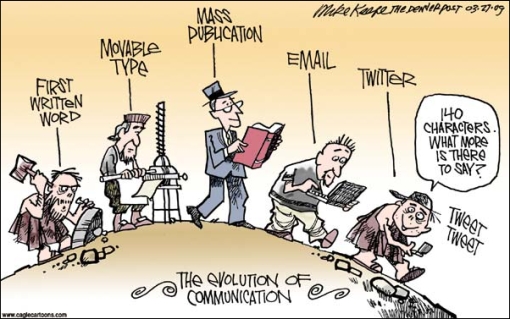
The Twitter Debate. Smith, Chelsey

Twitter has become a great controversy among the journalism students at Grant MacEwan University.

#macewan #macewanjsoc #media #newmedia #yeg #social media #web2.0 #jschool #news #journchat #twitter

Despite the expediency of the Internet site, many students and writers alike are rejecting the popular convenience or begrudgingly making accounts, but not bothering to take the time to learn how to navigate and/or reap the benefits.

I would argue that Twitter is one of the best social networking sites, and even better than Facebook for connecting people, groups, communities, and all who are Internet savvy. In that regard, I find Twitter to also be much more hassle free and inviting than many other forms of social media. Of course a small learning curve exists, but when searching for events, information, recipes, people, or whatever it is you desire, I generally find the site incredibly simplistic.

I use Twitter to read breaking news updates, to stay informed regarding events in my community and think it is hands down the best advertising and networking tool out there right now.

Sure it can be said that Twitter is self indulgent and narcissistic, but almost all tools of the current Generation X/Y or Look-at-me Generation are.

For an additional view of social networking sites see what Nancy has to say.


photo from urban dictionary, definition courtesy of candy kid

Blogging on a Blog Discussing Blogs - Elliott, Katie

The Canadian rapper Shad K who is based out of Toronto has a blog. The Nebraska State Historical Society has a blog. Seth Godin has a blog called Seth's Blog. Who is he? I’m not sure yet, but his web page comes up on the first page of a search in Google for 'blog', so I assume many people are interested in what he has to say (or he is at least extremely good at SEO).

Blogs seems to be everywhere you look. So many people are reporting these days on events which are either of interest or affect them, but many of them are not considered to be 'reporters'. Why? I don't believe it is merely the credentials of a diploma or degree that constitutes a persons ability to have adequate skills as a reporter; but it is a combination of a display of dedication to truthful story-telling and a pressure to up-keep a standard of excellence which can be validated through history, which makes news sources successful and valid.

Now-a-days anybody has access to use simple, even free, online programs such as blogspot or wordpress. People can create surveys on pollydaddy or charts and graphs on Create A Graph. All of this information can be assembled and posted (even look legit and professional) for the world to see. Citizens in action: citizen journalists -- though likely chocked full of bias and one-sided reveals, these blogs carry passion and are growing to be serious contenders for major news sources.

It is heavily debated whether this is "good" or "bad" for journalism and what it all means for the 'future of journalism’. Keeping away from business antics and political affiliation, I believe the key issue in question is how will people get the truth. Attempting not to sound too idealistic, but the without strict adherence to truth telling through factual explanations and equal importance given to all sides of a story we will all suffer from a lack of understanding in the world which surrounds us. This could lead to corruption in our government and judicial systems and serious issues in business and the health care sector. Without proper, honest communication about our society crumbles.

And even though this may sound extreme, this is my blog post: i'll say what I want.


Image Sources: Open Gardens Blog, Kelby Carr's blog, Catherine Marie blog

Editing Detective. Smith, Chelsey

Readers stumble across mistakes in the newspapers/sites more frequently than writers would hope. Some mistakes may be the misspelling of a word, some may be grammatical, and many errors are factual.

Finding errors when in search of the truth can be very frustrating for readers. Editors must work thoroughly and quickly with great diligence to avoid printed errors. This is becoming increasingly difficult with the advances in technology and the heightened need for speed in newsrooms.

Please see a few common errors I have found and discussed in a blog post, and additional errors can be found in Tyler Grant's Editing Detective post.

Certainly, mistakes are bound to happen; and they should be considered an opportunity to learn. On the other hand, I believe that carelessness is what generates many inaccuracies. Errors can be avoided through thorough editing, and scrutiny. Writers should be sure to allow time for editing, and for revision that checks dates, spelling, grammar, names, and facts.

My reporting instructor Shelly Decker emphasizes the importance of spelling names right, and I never understood how often this happens until it actually happened to me! When photographed for the Edmonton Journal Look section, my name was spelled Chelsea instead of Chelsey – this is a common misspelling of my name and had the photographer spoken to me for clarification, could have been avoided. Many of the other names of the models were mixed up or also misspelled.

I find that my own writing is prone to using improper verb and subject placement, and consciously try my best to be aware of this when writing. I also try to watch use of misplaced and dangling modifiers, as much of the red pen on my returned assignments signals this is often a recurrent blunder of mine. My writing has improved immensely since I began the journalism program at Grant MacEwan University, and I hope by the time I graduate that I have made all my mistakes and learned everything I can to be a great writer.


Photograph by: Walter Tychnowicz, edmontonjournal.com