Showing posts with label Lecture 2: Copy Editing and Review. Show all posts

Monday, March 22, 2010

Punctuation Review, Susan Eder

Exercise 14: (page 292, Creative Editing for Canadian Journalists textbook)

Use copy editing symbols to punctuate the following sentences

Note: Incorrect sentences are followed by corrected sentences.

a. Davis who is usually soft spoken talked in loud tones yesterday.
Davis, who is usually soft-spoken, talked in loud tones yesterday.

b. Pianist Glenn Gould who was known for his interpretations of Bach preferred the recording studio to touring.
Pianist Glenn Gould, who was known for his interpretations of Bach, preferred the recording studio to touring.

c. The 1,000 word story had a pro New Democrat tone and a definite anti Liberal slant.
The 1,000-word story had a pro-New Democrat tone, and a definite anti-Liberal slant.

d. The Manning who used to live here has returned to England.
The Manning, who used to live here, has returned to England.

e. The Supreme Court which is a nine member panel is Canada's highest court.
The Supreme Court, which is a nine-member panel, is Canada's highest court.

f. The home office is in Quebec City which is one of Canada's most beautiful cities.
The home office is in Quebec City, which is one of Canada's most beautiful cities.

g. The 25 member board held a five day conference.
The 25-member board held a five-day conference.

h. Headlines which are fashioned to summarize the stories are also used to display the news.
Headlines, which are fashioned to summarize the stories, are also used to display the news.

i. Citizens who voted for the new law now are regretting their lack of knowledge about its impact.
Citizens, who voted for the new law, now are regretting their lack of knowledge about its impact.

j. Durham shot his father in law with a 12 gauge shotgun and received a 15 year sentence when the 12 man jury recommended mercy.
Durham shot his father-in-law with a 12-gauge shotgun, and received a 15-year sentence when the 12-man jury recommended mercy.

Monday, January 18, 2010

Chapter 1 Review and Interpretation: Matt White and Chelsey Smith

In “Creative Editing for Canadian Journalists” chapter one begins by exploring the advantages and disadvantages of convergence and conglomerates in today’s media. For instance, due to conglomerates and convergence a lack of voice in stories has been a factor. Big corporations mean less voice/reporters, thus resulting in much of the news sounding the same. Companies like CanWest Global Corp and Quebecor have fused print, broadcast and internet properties into communications megaliths.

Many newspapers have different editors for different beats (entertainment, business, et cetera). There are many characteristics that make a good copy editor such as post secondary education, knowledgeable in fiction and non-fiction, previous experience in both reporting and editing, good grammar skills, ability to be non-confrontational with writers, and to be knowledgeable in many local and worldly affairs. Some of the duties an editor is responsible for would be objectivity, checking for grammar and spelling errors, maintaining the publication's reputation, providing humour, and fact checking for accuracy. Some factors that make a news story worthy are timeliness, relevance, and prominence.

In order for news to be organized and presented properly, a hierarchy is in place in most news rooms to ensure each step is fully met. The typical chain descends from publisher to editor-in-chief to managing editors, assistant editors, copy editors, and finally reporters.

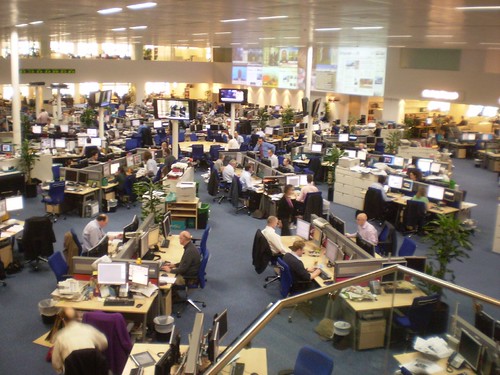
Two key terms found in this chapter are slot editor and rim editor. These terms refer to the old method of editing in which the slot editor sat in the middle of a semi-circle desk and the rim editors sat along the outside of the desk.


"The copy editor's work, day or night, is usually marked by roller-coaster fluctuations in activity."


Matt's thoughts on the chapter: I felt it was a good introduction to the course. It covered a lot of irrelevant information, but that's to be expected, especially in journalism. The thing that never ceases to amaze me is how poorly these textbooks are written. Meaning, they do not flow easily, nor do they capture and maintain the reader's attention. In a course that centers on writing, it's ironic how so many things we read are written in such a problematic way.

Chelsey found the first chapter to be elementary, yet informative. I agree with Matt in that the flow and overall format of the text is mundane and difficult to wade through, but yes; that is an expectation for one of my overpriced and underused school textbooks! I was most interested in the responsibilities and general aptitudes of an editor.
I often find editing, as a profession, to be more suited for me than journalism.
I am excited to move on to chapter two, and I hope to find more in depth, relevant, and exciting information.

Note: Image from Lloyd Davis