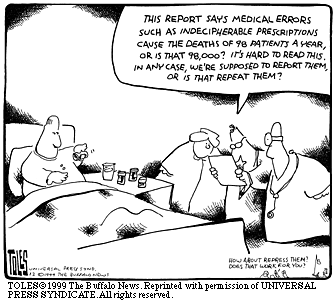
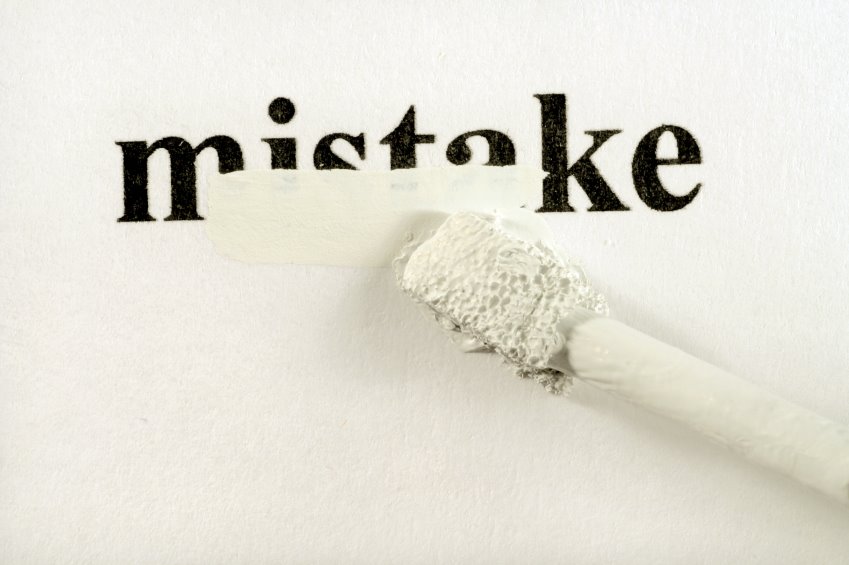
Showing posts with label Blog Report 2. Show all posts

Monday, March 15, 2010

We Regret the Error, Matt White

Fast is fine, but accuracy is everything. - Xenophon

Accuracy will always be one of the most important aspects of journalism. Beyond anything else, if an article/piece isn't accurate, it's nothing. Accuracy in facts and in grammar must be impeccable for quality journalism to truly exist. Facts are the essence of journalism; the bread and butter. Without them, we are blind. Not adhering to this golden rule of journalism can bring about dire consequences. An inaccurate journalist can lose all credibility, their job, and more. Even an
innocent mistake can force us to question the credibility of an author.

If their wrong about this, what else are they wrong about?

How didn't they catch this mistake, it's so obvious?

Can I trust someone who makes such simple errors?


Image by Erin M on flickr

It's questions like these put that much needed fear into journalists. In a recent article, Craig Silverman wrote that "journalists are conditioned to fear and avoid mistakes...," and he was right. Because of the extremely negative consequences that can come out of inaccuracy, journalists must always strive for the absolute truth, 100 per cent accuracy is essential.

Despite the fear of inaccuracy constantly being drilled into journalists, simple mistakes will always be made. When it comes to grammar, there isn't a writer out there who hasn't made a mistake at one point or another. It's inevitable. These mistakes are everywhere (three examples from local newspapers can be found at the bottom of this page). These types of mistakes are often pointed out, corrected, and may cause some embarrassment, but they are rarely taken so seriously as to bring about some of the major consequences mentioned above. The only way we as humans can deal with this writer's defect is to learn from our mistakes, and so we do.

"One of the best ways to learn how to avoid errors is to make them in the first place." - Craig Silverman

Silverman isn't the only one who supports this theory. An article published by ScienceDaily provides a scientific look behind this theory. It states that there is "a mechanism in the brain that reacts in just 0.1 seconds to things that have resulted in us making errors in the past." So we do in fact learn from our mistakes. Making simple errors is human nature, and it is our nature that allows us to learn and grow from these mistakes. However, when it comes to inaccurate facts, people can be far less forgiving.

Having inaccurate facts in journalism is seen by many as the ultimate sin. A journalist's job is to give the public a fair, accurate, and unbiased view of whatever is deemed to be news worthy. Losing anyone one of these three pillars seriously jeopardizes the quality of the work. Above all, if something has false statements and/or facts, it's worthless. The Cheating Culture gives a variety of examples of cheaters and fabricators of all kinds, including journalists. Steve Glass and Jayson Blair are obviously the most well known examples of inaccurate journalists, but there have been numerous cases for years and years. These men are not honoured or remembered for their inspiring words; they are remembered as the liars they were. They will always be remembered in a negative way, and that is perhaps the biggest consequence for journalists when it comes to inaccuracy, being forever disgraced without a shread of sympathy.

Errors: Screen shots were provided as opposed to links because many of these errors are spotted and corrected at a later date.

Example 1 - The Edmonton Journal


The word "quick" in the second line is being used incorrectly. For the sentence to make sense the word should have been "quickly."

Example 2 - The Edmonton Sun


Although it is hard to see, there is a small "3" in front of the 100%. I don't know why or how it got there, but it's an error nevertheless. For the sentence to be free of errors the author would have to remove the small number 3.

Example 3 - The Edmonton Journal


The error in this example is probably one of the most common errors. There are no quotation marks following the final quote of the paragraph. This would be a simple fix, just adding some quotation marks to the end of the sentence would fix the error.

We Regret the Error, Chelsey Smith


At the Gaze into the Stars conference at Grant MacEwan University in February, I was able to attain some helpful hints and insight into the industry through interviews with distinguished journalists and professional writers.

The most common advice I received was to write everyday.
Write every day, blog, and brainstorm.
Ideas should be endless.

Reading other materials and writing as often as possible will familiarize one to errors that are commonly made. Writing articles, stories, or journal entries on a frequent basis also allows for a style to be developed, and for comfort and familiarity with words and language to emerge.

Craig Silverman, an award winning author and journalist, insists that, “mistakes are bad, but also instructive.” Silverman explains that by making a mistake, the opportunity to learn arises that is not necessarily available otherwise, as accuracy is not like learning to add or subtract.

I agree with Silverman.

Accuracy and speed are two very important factors in the journalism industry, and are features that have to be learned through trial and error and well as consistent writing. Fear is good because it keeps writers on their toes. Fear ensures scrutiny, and rigorous spell checks. Fear keeps writers from getting sloppy. Fear of a mistake can also be bad; mistakes are just another way to ensure better work.

Alice’s Adventures in Filmland by Brian Gibson is featured in VueWeekly online. The article is very interesting and cleverly written; however, the end of paragraph two contains a sentence that holds the most commas I have ever seen. The comma-spliced sentences can be noted further throughout the story making it difficult for the reader to follow.

The Canadian Press Style Book: A Guide for Writers and Editors is my best friend. Perhaps I should be so kind as to send Kalvin Reid a copy. Reid wrote an inspiring article in th Edmonton Sun on a survey that displayed that young Canadian females are aspiring to more powerful careers vs. the more traditional. Unfortunately, the statistics and results were all written with a %, instead of being spelt out as per cent.

The CTV.ca website has an article titled “Calgary Researchers unlock gene secrets of opium poppy”. This article contains a deadly grammar sin that is not always easy to catch, and that can be very easy to make. The split infinitive.
“The 46-year-old Toronto-born scientist has been researching the opium poppy for close to two decades and, with the help of researcher Jillian Hagel, has been trying to specifically unlock the gene secrets for two years.”

The three errors above can simply be avoided by proofreading, and by always referring to The CP Style Book. I am sure the writers are much more wary of these instances their own writing and in others in the future.
Mistakes are inevitable, but how one learns from them is what is important.

Photo courtesy of artzy.viva on flickr.

We Regret The Error, K. Elliott

People make mistakes. This statement is nothing new, compelling or shocking to human beings because we grow up in a world of imperfection and utopian ideals, which are known as just that. Sighting imperfection and error in certain sectors of our lives is much more condemnable than others. A mailperson mistakably delivering a letter to a neighbours address instead of the one intended by the sender: forgivable. A doctor announcing one is soon to be deceased due to a cancer affliction, only to fess up to human err a month later (or vice versa): lawsuit.

This pressure for perfection is also placed on journalist and media types. The misspelling of a word such, as "benefeit" instead of benefit in the closing remark of the NxEW bio definitely makes the paper look unprofessional and unreliable. Even if a newspaper runs notice of correction to fix an error, such as they did recently in the St. Albert Gazette about misreporting on a survey, the initial damage may be done. The importance of our news and information to be current, understandable and correct is integral for media companies and the public, in order to maintain the current system that operates on a basis of reliability and integrity.

Yet, it should be understood that not everything you read in a paper or see on television is completely true. More and more media awareness is being urged and taught to younger people because of the impact and prevalence our media saturated world has on shaping youth and affecting peoples day to day lives. PBS has launched the “Don’t Buy It! Get Media Smart” campaign towards youth and many campaign programs are being created and centered on focusing minds on critical thinking skills and analytical processing as not to simply ingesting everything they take in as whole truths. This is very important.

Even if we pride ourselves on living in a world with a free press system in place which allows individuals the right to information sharing with minimal regulatory interference, it is important to note the basic regulations and stipulations which these information sharers must adhere to in order to keep the presses free. This includes being error free. There is no room for mistakes when the reputations of the persons in the story, the writer, and the media news producer are on the line and the shared knowledge of the public is at risk of being tainted with mistakes.

With this kind of pressure, it is no wonder journalists have fears of making mistakes. Not only could it cause an upset, but also legal troubles. This is why we go to school. Practice is the only way to attempt at perfection and though perfection may be too much of a utopian ideal, it is necessary to strive for. Craig Silverman, writer of Regret the Error: How Media Mistakes Pollute the Press and Imperil Free Speech, wrote his book and uses his website to report on “media corrections, retractions, apologies, clarifications and trends regarding accuracy and honesty in the press.” Silverman states his goal as being “aim[ed] to provide a non-partisan resource to serve both the press and the public; my overall goal is to help make news reporting more accurate and transparent.” But even Silverman is aware that human mistakes are almost completely unavoidable. “Perhaps this sounds a bit confusing: fear is good, but also bad; mistakes are bad, but also instructive. That's exactly the point. Teaching accuracy is a multi-faceted process.”

In order for most to learn, it takes making mistakes to truely understand how to do something correctly. School gives people a forum from which to practice and receive instruction with hopes that after their classes of practice sessions are over, they will successfully be capable of mastering the tasks in the work force. Correctly. Because journalists have a critical job to do, which have many people’s attention and room for error, no doubt, is minimal.


Image Sources: Emory University, clevland.com, Mooladays.com

We Regret the Error, Trevor Robb


Spell check just doesn't cut it anymore. Not quite sure it did to begin with but it certainly hasn't stopped the amount of online nonsense that makes it to "print" nowadays. This just proves that the only person that can succesfully mediate gramitical errors in his/her writing is the author themselves. Craig Silverman is absolutely correct when he says that "one of the best ways to learn how to avoid errors is to make them in the first place." I can't remmeber how many mistakes I've made, only once. Never to be repeated again. That's how I learn. It seems that's not just a personal trait. Therapeutically speaking, this is good news. Still, mistakes are made and as journalists this can be very embarrassing. Copy editors too, as their eyes are the last to see and edit the text before it goes to "print". These issues seem easy to avoid and even easier to correct, especially if your job is correcting grammatical errors, but be that as it may let's take a look at some inaccuracies in todays online news publications.


Accuracy, or inaccuracy in this case, doesn't just stop at incorrect spelling. Sentance structure and fact checking can also lead to brutal inaccuracies in the journalism field. Fact checking has to top the list of things needing to be accurate. Nothing worse than priniting inaccurate or even ambigious information. Especially when comes to death. The Sun published an article regarding Dave Burns, the man who shot and killed his former employer at Great West Honda in Edmonton, early Friday morning. It seems the journalist isn't quite sure how old Burns is so he runs it like this: "Burns, now 54 or 55, was charged with murder but pleaded guilty to a reduced charge," 54 or 55? Which one is it? How do you not know that? They don't even bother to explain it either. This is ridiculous. As a reader I couldn't help but laugh. As a journalist I can't help but shake my head in confusion. Hopefully this reporter learns from his/her mistake and gets the age of the next killer/suicidal maniac correct.


Sentance structure is equally important. As students we learn about comma splices, fused sentances and run-on sentances very early in our education and it all seems like mundane nonsense but everyday writers fall victim to these grammatical inaccuracies. Writing a lead can be difficult, especially if you're trying to fit a lot of information into it. The Associated Press posted an article on The Sun website where the lead was a classic example of a comma splice. "At least 94 people living near a lead factory, most of them children, have tested positive for lead poisoning, state media said Monday, prompting authorities to order the closure of the plant." It pains me to read these leads. I never bothered to read the rest of the article, despite it being an important article. Children with lead poisoning? That is absolutely despicable but I could just as easily find a different article, written by a different journalist. Inaccuracy leads to distrust. Sooner or later the public picks up on publications that continuously print errors.


The Edmonton Journal posted an article regarding the legal age limit for senior citizens. This is an important issue for society and for me personally having lost a friend to a car accident involving a senior who crossed the median on a secondary highway. The artcile has a paraphrased, not a direct, quote that falls terribly into subject/verb disagreement based on number. "The consequences of stripping a senior's licences also hang heavy in doctors' minds, he said"." Once again, not a direct quote. Licences should be singular. Easy fix. Should have been take care of, but it wasn't. Lucky for me. Still this demonstrates the fact that mistakes still occur in the news world. They happen all the time. The only way to limit your mistakes is to make them and learn by them, just as Silverman says. Can't say it any better. The man is dead on.


Picture taken from detbuzzsaw from Flickr

We Regret the Error: Blog Report 2


Errors are a crucial part of any writers job. Editing and proofreading a piece of writing is crucial for clarity and readability. No writer will catch one hundred percent of his/her errors all the time, their is usually room for improvement in most writing. Journalist face extra stresses because of the time constraints that come with deadlines; therefore, they must learn to edit quickly and efficiently. I would have to agree with Craig Silverman, the best way to learn from mistakes is to make them. In writing, just like in any art or skill, practice makes perfect. This is true with accuracy and errors as well. Even proffesional journalists make mistakes when the news needs to get out quickly, but in accordance with Silvermans statement, the more time spent writing to quick deadlines the less errors you will make. I founds some commom clarical and grammatical errors in Canadian online news.

I found this run-on sentence on macleans.ca in the article "Politics of fear." This sentence continues on and on with commas and begins to be hard to understand. The article read somewhat smoothley up until this paragraph, the lack of clarity and a confusing unattributed quote made it hard to read this paragraph/sentence: "I had thought, and written, that the return of Parliament, after all the controversy over prorogation, would see “a ferocious battle of narratives” between a government determined to use the dual occasion of the Throne Speech and budget to shift the agenda on to its preferred ground of the economy, and an opposition equally determined to keep the heat on the government over its handling of the Afghan detainees file, and its refusal to hand over the documents Parliament had demanded in this regard." When a sentence runs on like this it can turn readers away from the article, especially after they have read the lead. People browse quickly through articles online and will tend to move on if the article becomes difficult to read.

In the article "World's smallest man dead at 21: Guinness World Records," on the lead contains a Canadian Press style error: "The world's shortest man, He Pingping, who stood just over 2-foot-5 inches tall, has died, Britain's Guinness World Records said Monday. He was 21." The sentence should read "...who stood just over two-foot-five inches tall." also the first part of the lead could be reworded. "The world's shortest man, He Pingping, 21, who stood..." or "...inches tall, has died at 21, Britain's Guinness..."this way the lead can work as one sentence instead of two.


In the article "Docs need standard method to ID seniors' driving skills," one sentence reads "The consequences of stripping a senior's licences also hang heavy in doctors' minds, he said." The article a is singular while licences is plural. The sentence also reads like an alliteration out of a Dr.Suess book, but is still grammaticly correct aside from that error. Nobody's perfect, and there is no way to fully elimate errors in your writing, so the only way to practice is to, of course, write.


We Regret the Error, Tyler Grant

Photo courtesy of listservice.com

Accuracy in writing is an integral part of any story as it lends clarity to the what the story is about. The more mistakes there are, the more likely a person is to dismiss the story. Why would anyone waste time reading a story where the author didn't bother spending time looking for his errors? Sure, if the story is breaking news, an error or two might be made as a small sacrifice in getting the story out as quickly as possible, but that's why a second set of eyes is vital before a story makes its way into the realm of published material.

Everyday, newspapers across Canada publish stories with mistakes. On Friday, March 12th, The Edmonton Sun published a story about a lone gunman walked into a car dealership wounding one and killing another before taking his own life. A blemish on what was otherwise a good story was when the author quoted a witness. The quote read: "Dave walked in there, didn't say a f---ing word. He came here with a vengeance and a rage. He came there to kill," said the staff witness, who does not want to be named." The problem lies with the expletive "f---ing." Were the full word "fucking" written out, then the article "a" would be correct. However, with the way the word is written out now, the indefinite article "an" would have a nicer ring to it. I can see why the author wrote what he did and the editor let it go, but it did make for a chop in my Monday morning reading.

Although that little mistake wasn't too bad, The Edmonton Sun opted to publish something a little more confusing. "The SUV showed up in front of the Heaven Bar around 4 a.m. and several gunshots rang out, hitting four of the bar's patrons standing outside in the legs." Is "the legs" what the folks in Montreal have nicknamed the smoking section outside bars, or did the people receive gunshot wounds to their legs? I'm going to guess it was the latter. Even the simplest mistake can inhibit clarity. Let's hope the author learns from his mistake.

Not only can a person learn from making mistakes in writing, but that person can also learn from reading mistakes in the writing of others. The more you read, the better your writing gets. The better your writing gets, the easier your writing is to read. Journalists can also learn how to punctuate sentences from listening to the people they interview. In Monday's on-line version of The Edmonton Journal, Phil Dukarsky quoted Richard Moffat of Environment Canada as saying, "Precipitation has been close to normal and they've had normal rainfall so I don't think there should be a drought." Unlike the previous quote, the sentence is still clear, but where are the commas? There are a few ways Dukarsky could've punctuated that sentence, but he opted simply end it with a period. This story was published on-line at 11:13 a.m., so there's still a chance it could be corrected later in the day.

These three examples of slips in writing are not out of the ordinary. Writers are people, and people make mistakes. If I were to read this block of paragraphs over and over again, I'm sure some mistake, or mistakes, would jump out at me. If anything comes to my attention, at the very least, I hope I would be able to learn something for my future writing.

We Regret The Error, Isaac Kaplyuk

Photo from www.journerdism.com


Accuracy within journalistic writing is an attribute that every writer, editor, and publisher strive for. Any error made inprint is a grave mistake, a tarnish upon a news institution's polished reputation; however, mistakes can not be avoided, and because people are not perfect beings, mistakes are unavoidable, and whether it be 3000-population Lac La Biche Post, or the New York Times, no publication is safe from the wrath of a mistake made in print, whether it be a literal error, or an error caused by faulty information- no one is safe from the print error forever. The grave print error could be seen by readers as a reflection upon a news group's reliability, thus making a mistake that is published is to be avoided at all costs. This is why practices such as proofreading and copy-editing exist-to catch an error before it's actually printed. Lessons and improvements can always be crafted from mistakes, but the goal is to catch the error before ink hits paper or the Send tab is hit. Journalists are conditioned to fear mistakes, and rightly so-accuracy is key in journalism.


Out of all the mistakes printed in the news, many of them are simple, oft-overlooked typographical errors, such as this one, caught in the Edmonton Sun, in an article ironically headlined 'Pandas Were Perfect', with perfection not being the case with this article. The error noted reads: "Leah Copeland and Stephanie Ramsay jonined Vinge on the tournament all-star squad, while Ramsay was tournament MVP." The offending mistake is the mispelling of the word 'joined', a simple error, overlooked most likely due to haste-an unfortunate ailment in the deadline-driven industry of Journalism. Although typographical areas rarely perturb someone so much so that they don't understand a part of the article, they still aid in making the article appear less reliable, and it's obvious that the article was rushed. With articles being short and broken up, a careful once-over for typos wouldn't be a task that eats up alot of time, and small errors like those could be quickly fixed, aiding to create an article that appears much more reliable.

Although typos occur to the best of writers and are common due to the nature in which the mistake is made ( a slip on the keyboard, an extra, unnoticed letter-piizza anyone?) making typos something of a common occurence, when referring to errors found in a news story. Other common errors are grammatical ones. This could be anything from an ommitted period, comma, apostrophe, hyphen or other grammatical signs, to an awkwardly worded sentence that just doesn't make sense. One such error is found, once again, in the not-so-perfect 'Pandas Were Perfect' article. The offending error in this case, is simply a phrase in a paragraph all on its own, with nothing written but 'Bears bummed' , and also missing its period, making it an incomplete sentence. To give more context to the error, here is the paragraph before the error, and the paragraph after, taken verbatim:


"The Pandas will arrive at the Edmonton International Airport with the banner on tonight at 8:40 p.m. on WestJet flight 533.

Bears bummed

As expected, the two top volleyball teams in the country met in the CIS championship tournament, but they weren’t playing for the gold medal."

This was published March 14,2010. So what does the phrase in the middle mean? Was it the start of a new thought that didn't get finished? What's missing? These, and other questions remain unanswered. Although a simple looking error, there is no context for it, and it really just doesn't make sense, especially considering the article's headling is penned 'Pandas Were Perfect'.


Although grammatical errors are harder to find, one that is quite commonly found is instances in which an apostrophe is, or isn't used. Chicken wing's and Beer, anyone? This is a grammatical fault in which students have had drilled into their head to avoid since the earliest years of english grammar education, yet, it's a quick and easy mistake to make, and one that a Vue Weekly writer made in a recent article about sexual assault.

"To ensure anonymity, the survivors name is not attached to the file." The survivors? Is this a group, or is it a name belonging to an individual surivor? Because an apostrophe was forgotten to be included, the actual meaning is ambiguous. Even if it was a group, an apostrophe is still needed, because in this case, the word 'name' is something belonging to the survivors, hence it should read "Survivor's name", not "Survivors name.", because an apostrophe is Although a small, almost unnoticeable mistake, it is still one that may cause confusion, and is a mistake that is easy to overlook by both writer and editor. Because apostrophes are also used to make contractions of words, it may become confusing as to where to use an apostrophe, which consequently makes it difficult to understand when there isn't one when there is supposed to be.

Although journalists are conditioned to fear mistakes, they will still happen, despite editor's and writer's best efforts to do so otherwise. In today's world of journalism, with the advent of the Internet, iPhones, blogs, Twitter, RSS feeds and much, much more, the journalist is required to write meaningful, newsworthy, and accurate reports, in a fraction of the time. Time indeed may be a critical source of many errors found in online newsgroup's stories, and no doubt may be an unavoidable occurence as haste required to post a story before a competitor does, or before an uncredible writer posts a blog about it, making the career journalist look incompetent. Because of the nature of the way things are handled in the 21st century, mistakes are bound to occur, despite a journalist's best efforts. However, people are not perfect creations, and are fallible. Mistakes, whether in print or in some other medium will occur time and time again. Journalists can be indoctrinated to fear mistakes, errors, and innaccuracies from the beginning, and although errors of large magnitude are severely limited, errors will occur from time to time, with the best explanation behind them being people are only human, and errors are always made-it's just a fact of life.

We Regret the Error, Nancy Gordy

If you make a mistake once, you will seldom make the same mistake again. At least this is what any journalist would and should expect to be the case.

When a mistake is made, some sort of consequence will occur be it regrettably big or so small it may go unnoticed to the writer; however, the outcome will hopefully be a learning experience. "Perhaps this sounds a bit confusing: fear is good, but also bad; mistakes are bad, but also instructive," Craig Silverman, a freelance journalist and author out of Montreal, states. Fear is good due to the way it stimulates one to write with caution in order to be accurate and free of error. Journalists must demonstrate accuracy for it is a key component of journalism. Without accuracy, a journalist is left with a bad reputation, in turn deeply affecting the reputation of who they write for as well.

Mistakes are bad for the obvious reason. Mistakes will negatively affect one's writing and can cause confusion and lack of loyalty if it becomes a continuous problem. Even though most writers go over their work again and again to ensure that there are no errors and often will get a second set of eyes to go over their work as well, mistakes can still go unnoticed.
Journalists must also meet tight deadlines at times, which adds to the probability of mistakes being made. While errors are tough to correct when in print, they are able to be easily corrected when done online. It is simply a matter of being able to identify the error once it has been published and fixing it.

The Edmonton Journal's website on Friday morning had an error in the headline for a story on the shooting at the Chrysler dealership. I have provided a photo of this error above. The writer was obviously racing the clock to get the breaking news story out and wrote "Toe dead..." rather than "Two dead...". This definitely could have caused some confusion at first if the reader was not able to identify the mistake on their own. Thankfully, the error was corrected quite quickly.

I was able to find another error on the Edmonton Journal's website from a story on the same breaking news event (the Chrysler dealership shooting) soon after i discovered the error in the headline. The simple addition of 'at' next to the word 'on' demonstrated another example of a mistake made when under the pressure to get a story out immediately. It read "Police are scouring the scene at on Stony Plain Road after shots rang out just before 8 a.m. Friday."

I was also able to find an article written on the Edmonton Sun's website that contained a very confusing error. The error read "The Afro-inflected pop group has only two records to their name (the first landed them on the cover of Spin magazine in 2008 and declared the masterminds behind the best album of the year. In February of that year.), but it's been enough to win them a growing legion of fans from across the music spectrum." I am completely unsure as to what was meant within the brackets. There is an unfinished sentence at the end in the brackets, followed by a period inside of them, and then a comma on the outside. This needs to be re-written properly. Instead it could read "The Afro-inflected pop group has only two records to their name. The first record landed them on the cover of Spin magazine in 2008 and in February of that year they were declared the masterminds behind the best album of the year." This article was last updated at 11:04 a.m. this morning and has not been touched since then. There's still time to fix the error! Will it get fixed?

As Silverman said, "mistakes are bad, but also instructive." Being able to learn how to write properly and free of error is a very long process that involves making a lot of mistakes. As there are an endless amount of mistakes one can make, the ability to continue to learn from errors can last a life time. Every time a mistake is made, the writer will often learn something new for they wouldn't have made the mistake if they were already aware that it was a mistake in the first place (unless they are just lazy). Nate Kornell, author and assistant professor explains this well by saying that "making errors is the best way to learn information that you want to learn."

Readers will always expect accuracy from journalists and so it is the writer's duty to fulfill this expectation through facts, grammar, spelling, punctuation, etc., and when a mistake is made, it must be excepted as a learning opportunity (that won't need to be repeated).

Note: Image from Edmonton Journal

Sunday, March 14, 2010

We Regret the Error, Erik Nelson

Accuracy is perhaps the single greatest responsibility that journalists have to undertake to maintain credibility as a journalist. Errors can show up in articles in many different ways such as grammatical errors, misquoting sources, forgetting information, and the creating content. Although the severity of each error is weighed differently, readers need to be able to trust journalists 100 per cent of the time and thus accuracy is so important for journalism.

Making an error can be constructive for journalists though because it allows the writer to see how something is wrong, why it is wrong, and also how to fix what is wrong. When a word is misspelled and an editor hands back your copy with spelling mistakes circled, in your head you analyze the wrong spelling and because you have seen the error circled, the writer will remember the correct spelling. Just as shooting basketballs at a hoop, not all the balls will land but you will progressively get better once you analyze how to shoot a ball properly.

As found in the Edmonton Sun - Cabbies float flat airport rate:
"City cab drivers hope that offering the lower of either a flat rate or meter rate for passengers heading to the international airport could mean a big boost to their flailing business."
The use of the word flailing according to a dictionary would suggest that the business is "To wave or swing vigorously". Since businesses cannot swing around vigorously, another word should be used to correct this error, one such word being "declining".

In the 24 Hours Edmonton - Google Ready To Leave China
"Talks with China over censorship have reached an apparent impasse and Google, the world’s largest search engine, is now “99.95” certain it will shut down its Chinese search engine, the FinancialTimes said on Saturday. "
In this article, the journalist quotes someone stating a number, but he doesn't include anything for the reader to relate the number to. Is it 99.95 people that are certain of the closure? It appears that the number is meant to be a percentage, however the reader cannot be certain about this unless the writer states it as such.

Another error was in the Edmonton Journal - Young Edmonton teens charged with transit-station attacks
"The first assault allegedly happened just after 10:30 p.m., when one of the girls in the group walked up to a 16-year-old boy and grabbed his cellphone and bus bass."
Although this is another simple mistake, it must be noticed because there is no such thing as a bus bass. It is not hard to decipher the mistake which should be "bus pass", hopefully the journalist will not make this mistake again.

News articles filled with errors are disappointing to see because of the high standards that are maintained at most newspapers, however it is only human to make mistakes. To make a mistake and correct it allows writers to grow and learn. Although making errors should be feared and all measures should be taken to avoid them if at all possible, it should be remembered that the only way to move up is by falling down (and then picking yourself up again).

Image from Brain Leaders and Learners in the article From Mistakes to Brainbower.

Lecture 9: Blog Report 2

Blog Report 2 is due on the 15th of March and we'll be devoting that class (Monday March 15th to completing the blog report.


Blog Report 2:

Due: March 15th
Title: We Regret the Error, Name Surname
Label: Blog Report 2
Length: 4 paragraphs

REMEMBER to cite any images appropriately

Respond, using examples and in an academic tone:
“Journalists are conditioned to fear and avoid mistakes. This helps send the message that accuracy is important. From there, the best course of action is to help mitigate the fear by teaching practices and introducing tools that help prevent factual errors. Fear of mistakes doesn't lead to accuracy. In fact, one of the best ways to learn how to avoid errors is to make them in the first place. A study recently published in the Journal of Experimental Psychology: Learning, Memory, and Cognition is just the latest piece of research that suggests, as lead author Nate Kornell, an assistant professor of psychology at Williams College told me, that "making errors is the best way to learn information that you want to learn." Perhaps this sounds a bit confusing: fear is good, but also bad; mistakes are bad, but also instructive. That's exactly the point. Teaching accuracy is a multi-faceted process. It's complicated, and in truth it never really ends. You can't learn accuracy the way you learn to add and subtract. It's a process and a combination of learned behaviours, not a matter of memorization or motor memory.” ~ Craig Silverman

Include at least three mistakes made in Canadian newspapers (online versions)
Note the inaccuracy
Example:
“In a story on Page 3-A of Wednesday’s Independent about the Big Brothers Big Sisters’ Trail of Terror haunted house, a reaction to strobe lights should have included the word “freaking.” The word was replaced with asterisks, perhaps causing confusion about what was actually said. The Independent apologizes for this confusion and the impression it left.” — The Grand Island Independent


Note: Image from UK Link Building Co.

Thursday, March 11, 2010

We Regret the Error, Susan Eder

WE REGRET THE ERROR
image courtesy of "something to chew on"

To operate within the law, writers who report the news, must be careful to report the truth. To make life easier for an editor, writers should also be able to provide grammatically correct copy. Journalists are conditioned to fear and avoid mistakes not only for ethical reasons, but also for fear of being sued. When journalists are conditioned to be afraid they get the message that accuracy is important. We respect what we fear and as a result we are more careful.

Of coarse teaching writers how to check their work for accuracy provides confidence in both the author and the editor. The author learns the truth and the editor learns to trust the author. Tools that help prevent factual errors also help to prevent some mistakes. But the fear of making mistakes doesn't always prevent mistakes from happening. However, mistakes are not always bad. Craig Silverman, award-winning journalist and author, says we can learn from our mistakes. "In fact, one of the best ways to learn how to avoid errors is to make them in the first place...making errors is the best way to learn information that you want to learn," said Silverman. Our mistakes teach us valuable lessons.

People will make mistakes no matter how careful they are. To err is human, they say. Mistakes may arise from a variety of situations. Rushing to meet deadlines, may produce errors. The time needed for proofreading is often short, especially for breaking news stories where information needs to be uploaded as soon as possible. A lot of mistakes come from the author being too close to the work. Writers should get someone else to edit their copy. Sometimes though, when time permits, a short rest between writing and editing helps to find grammatical errors.

Using spell check programs and other proofreading and editing software programs is a good start for checking work for grammatical errors; however. it is still necessary to manually check for mistakes. Simple words like "too, two and to," will never be recognized by these computer programs. (See my blog about spelling) Nancy Gordy also wrote a blog about spelling. Fact checking by calling on sources, doing research and checking on everything will help eliminate factual errors.

Silverman points out that mistakes are both good and bad and that "you can't learn accuracy the way you learn to add and subtract." The process of learning to be error free isn't as simple as one, two, three, but rather a set of rules the writer writes to help guide the writing of error free copy. This process must be learned. Accuracy says Silverman is "a process and a combination of learned behaviours, not a matter of memorization or motor memory." So through experience, awareness and education, errors can be reduced, but only if we are committed to doing so.


THREE EXAMPLES OF
RECENT ERRORS IN
LOCAL ONLINE NEWS STORIES


St. Paddy's green routine


by Chris O'Zdeb, Edmonton Journal, Monday March 15th 2010.
  • This article has a couple of errors. In the first sentence the word korezone.com is separated by a space from the bracket before it. This looks like sloppy work.

  • In the sixth paragraph the words "both hands" are used. This is redundant as more than one hand implies the use of both hands.
Auction for 5 orphaned kids


by Jenna McMurray, Edmonton Sun, Monday March 15, 2010.
  • The title is misleading. I really thought that they were trying to raise money by "auctioning" the kids off. After reading the article I understood the fundraising was to help the kids. The headline would have been better if it said "Auction to help 5 orphaned kids."
Nearly 15,000 jobs lost in Alberta in February


CBC News, March 12, 2010
  • In this article the writer uses the same words that are used in the quote. The quote says in the fourth paragraph up from the bottom, that "we are still attracting..." while in the next line the writer repeats "we are still attracting...." This made me do a double take. I had to read the text over again to make sure I did not read it wrong.

  • The headline is so long that is does not fit across the page but rather the word February is on a second row. Reducing the font size would allow all these words to fit on one line.

Monday, March 1, 2010

Blog Report 2

Blog Report 2:


Due: March 15th

Title: We Regret the Error, Name Surname

Label: Blog Report 2


Respond, using examples and in an academic tone:


“Journalists are conditioned to fear and avoid mistakes. This helps send the message that accuracy is important. From there, the best course of action is to help mitigate the fear by teaching practices and introducing tools that help prevent factual errors. Fear of mistakes doesn't lead to accuracy. In fact, one of the best ways to learn how to avoid errors is to make them in the first place. A study recently published in the Journal of Experimental Psychology: Learning, Memory, and Cognition is just the latest piece of research that suggests, as lead author Nate Kornell, an assistant professor of psychology at Williams College told me, that "making errors is the best way to learn information that you want to learn." Perhaps this sounds a bit confusing: fear is good, but also bad; mistakes are bad, but also instructive. That's exactly the point. Teaching accuracy is a multi-faceted process. It's complicated, and in truth it never really ends. You can't learn accuracy the way you learn to add and subtract. It's a process and a combination of learned behaviours, not a matter of memorization or motor memory.” ~ Craig Silverman


Include at least three mistakes made in Canadian newspapers (online versions)

Note the inaccuracy

Example:

“In a story on Page 3-A of Wednesday’s Independent about the Big Brothers Big Sisters’ Trail of Terror haunted house, a reaction to strobe lights should have included the word “freaking.” The word was replaced with asterisks, perhaps causing confusion about what was actually said. The Independent apologizes for this confusion and the impression it left.” — The Grand Island Independent


Note: Image from Altgate.